Beautiful Broken: Why the Glitch Became Gen Z's Most Honest Art Form
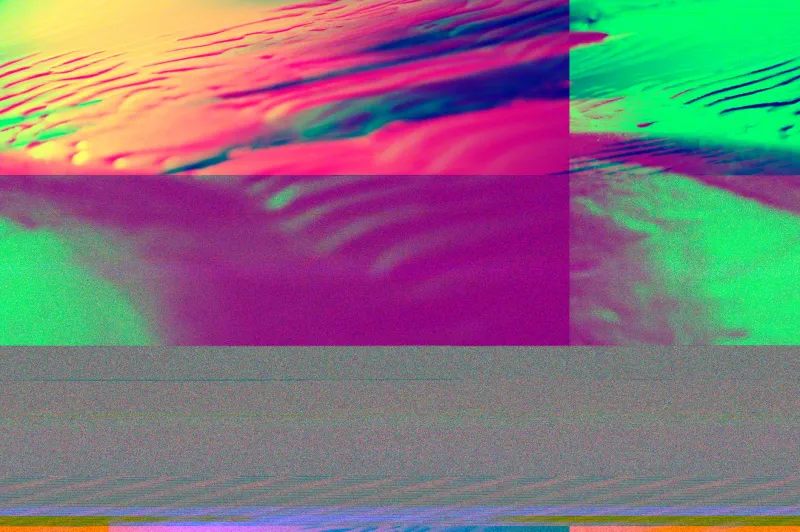
Something went wrong. And it looked incredible.
That sentence — that precise reversal of expectation — is basically the founding document of glitch art. What started as the accidental byproduct of failing hardware and corrupted data has evolved into one of the most culturally loaded aesthetics in contemporary digital art. The glitch isn't a mistake anymore. It's a message.
Error Has a History
To understand where glitch art is now, you have to go back to where it came from — and that means getting comfortable with ugly.
The early internet was not beautiful. It was janky GIFs, broken image tags, and text rendered in fonts that looked like they'd been through a shredder. But embedded in that ugliness was something honest: you could see the seams. You could feel the effort and the limitation. The technology wasn't pretending to be seamless because it didn't know how.
Artists started noticing this in the late '80s and '90s. Nam June Paik was manipulating video signals with magnets. Yasunao Tone was deliberately scratching CDs to corrupt the audio. These weren't accidents — they were interventions, ways of making visible the usually invisible infrastructure of digital media.
By the early 2000s, glitch had its own scene, its own festivals, its own vocabulary. Datamoshing (corrupting video compression to create fluid, melting visuals), circuit bending (rewiring cheap electronics to produce chaotic sounds and images), pixel sorting (algorithmically rearranging pixel data to create smeared, dreamlike distortions) — these became legitimate techniques with their own communities and canons.
Then the internet got fast and clean and corporate, and glitch went underground for a while.
TikTok Broke the Dam
Here's where it gets interesting. TikTok — of all platforms — became the unlikely vector through which glitch aesthetics re-entered mainstream visual culture. Not because TikTok is avant-garde (it is not), but because its compression artifacts, its duet features, its tendency to degrade video quality across reposts — all of these created an environment where glitchy visuals felt native rather than imported.
Gen Z creators, raised on this aesthetic without necessarily knowing its history, started leaning into the degradation. Intentionally lo-fi footage. Deliberately corrupted transitions. VHS overlays. Scan lines. Color bleeding. The visual language of things falling apart, applied with total intentionality.
"There's something that feels more real about footage that looks like it's been through something," says Jordan Lee, a 21-year-old video artist from Chicago who goes by the handle @softerror online. "Pristine 4K video feels like an ad. Glitchy video feels like a memory."
That's not a throwaway observation. It points to something deep about how Gen Z relates to documentation and authenticity. In an era of hyper-polished content, imperfection has become a signal of genuineness — or at least, a very convincing simulation of it.
The Philosophy of the Broken Thing
Glitch art isn't just aesthetically interesting. It's philosophically loaded in ways that deserve unpacking.
At its core, glitch art is about making visible what technology usually hides. Every digital image is a compressed set of instructions, a series of calculations performed so fast and so smoothly that we forget they're happening. When that process breaks down — when the codec gets confused, when the file gets corrupted, when the signal degrades — we suddenly see the machinery underneath. The glitch is a window into the guts of the system.
There's a direct line from this to broader cultural anxieties about technology's role in our lives. We interact with algorithms, platforms, and interfaces that are deliberately designed to be opaque — to feel natural and inevitable rather than constructed and contingent. Glitch art refuses that seamlessness. It insists on the artifice.
In that sense, it's deeply political, even when it doesn't look it. A corrupted Instagram post is a tiny act of resistance against the platform's insistence on perfection. A deliberately lo-fi music video is a rejection of the production values that gatekeep professional legitimacy.
Sound Has Glitched Too
The conversation about glitch aesthetics tends to center on visual art, but the parallel movement in music is just as rich. Glitch music — artists like Oval, Autechre, and more recently the entire PC Music and hyperpop universe — has been using digital error as compositional material for decades.
The crackling, stuttering, impossibly fast percussion of early Autechre records. The deliberately cheap-sounding synths and pitch-corrected vocals pushed to grotesque extremes in hyperpop. The lo-fi hip-hop aesthetic that wraps everything in tape hiss and vinyl crackle. These are all, in different ways, glitch aesthetics applied to sound — the intentional introduction of degradation as a form of expression.
What's notable is that as production tools have become more powerful and accessible, artists have increasingly used them to simulate limitations. You can make a perfectly clean recording in GarageBand on your phone. The choice to make it sound like it was recorded in a collapsing warehouse is exactly that — a choice. A statement.
Authenticity's Weird New Address
Here's the tension that makes glitch art genuinely interesting rather than just a trend: at some point, the intentional glitch becomes its own kind of perfection. If you're carefully crafting a look of digital degradation, you're not actually breaking anything — you're just adding a new layer of polish, one that happens to look like its opposite.
This is the paradox that every avant-garde movement eventually runs into. The authentic becomes a style. The transgressive becomes a template. The underground gets a Spotify playlist.
But maybe that's okay. Maybe the value of glitch art isn't in maintaining some pure relationship with actual error, but in what it keeps insisting on: that the broken and the beautiful aren't opposites. That imperfection carries information. That the seams of a thing are as interesting as the surface.
In a digital landscape obsessed with optimization — smoother interfaces, faster load times, cleaner outputs — there's something genuinely radical about an aesthetic that says: no, actually, let it break. Look at what breaks. That's where the truth is.
The glitch isn't going away. If anything, as AI-generated content floods every platform with hyper-polished unreality, the corrupted signal is going to feel more and more like the only honest thing on the screen.